
Peer Review Process
The Journal of Community Development and Sustainable Futures (JCDSF) was founded to address the growing need for a high-quality scholarly platform dedicated to community empowerment, participatory development, social innovation, and sustainable futures. Conceived as a multidisciplinary forum, the journal brings together researchers, practitioners, policymakers, and development stakeholders to advance evidence-based approaches that strengthen community resilience, enhance social well-being, and promote environmentally responsible development. By supporting rigorous empirical studies and conceptual contributions, JCDSF seeks to foster inclusive, ethical, and sustainable community transformation across diverse local and global contexts.
In line with international scholarly publishing standards, the journal continuously enhances its operational framework by adopting best practices in research integrity, editorial transparency, and publication ethics. JCDSF implements a double-blind peer-review system to ensure impartial evaluation, protect author and reviewer identities, and minimize potential sources of bias. All manuscripts deemed suitable for consideration undergo review by at least two external experts possessing relevant subject-matter expertise.
The journal’s peer-review procedures are fully aligned with the principles outlined in the COPE Ethical Guidelines for Peer Reviewers (Committee on Publication Ethics), ensuring that reviewers adhere to internationally recognized standards of ethical conduct. This includes maintaining strict confidentiality, declaring any potential conflicts of interest, providing objective and constructive evaluations, avoiding the use of privileged information for personal advantage, and ensuring fairness throughout the review process. Reviewers are expected to offer clear, evidence-based assessments and to deliver their feedback in a timely manner to support an efficient editorial workflow.
The decision to accept or reject a manuscript is determined by the editorial board and is fully based on the reviewers’ evaluations. The initial assessment focuses on the manuscript’s relevance to the journal’s scope and its novelty, which is conducted by the editor. Only manuscripts that pass this preliminary screening proceed to the review stage. To ensure an objective evaluation, each submission is typically reviewed by a minimum of three reviewers: one internal reviewer from Universitas Pendidikan Indonesia and at least two external reviewers.
During the review process, no direct communication is allowed between authors and reviewers. Likewise, authors cannot correspond with editors regarding rejection decisions.
Authors will be notified of the review outcomes, whether their manuscripts are accepted, require revision, or are rejected.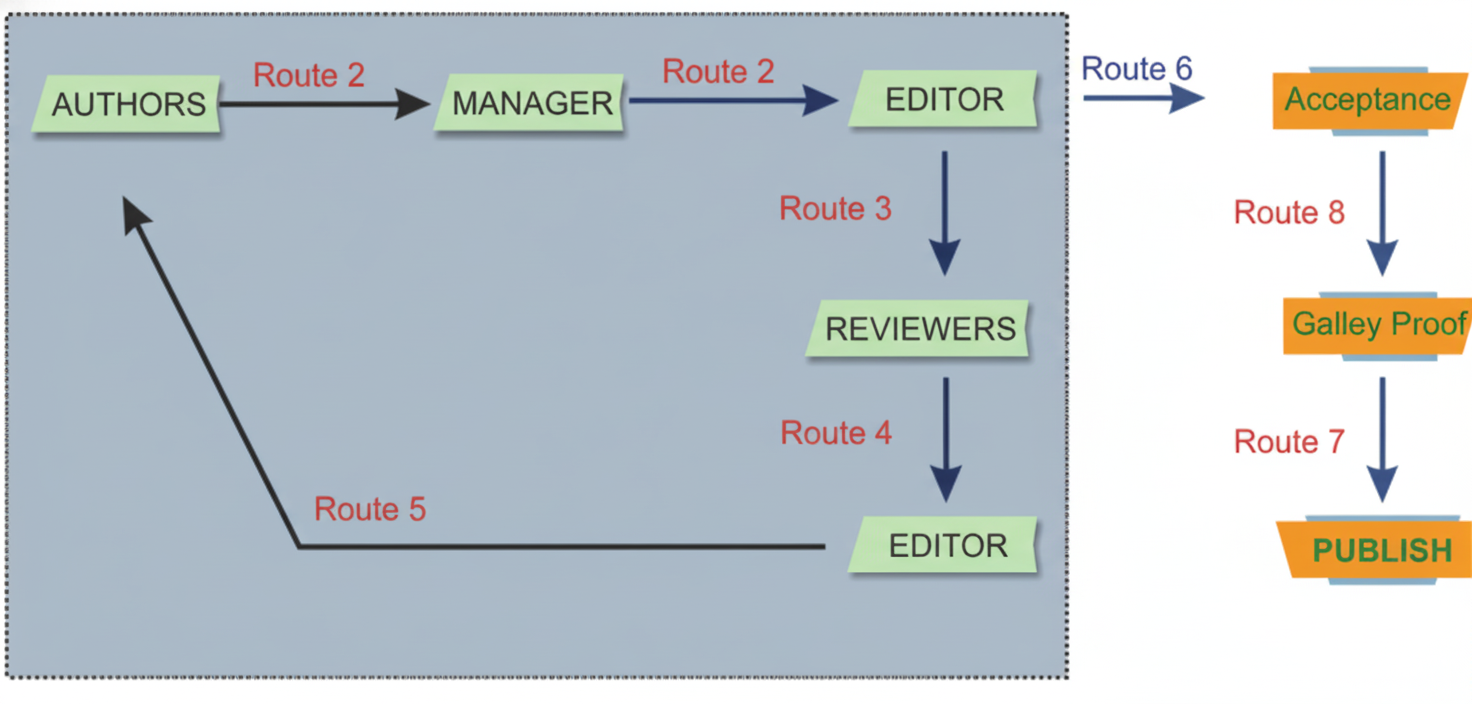
The review workflow follows the sequence illustrated in the figure and may be summarized as follows:
- Manuscript Submission by the author (route 1).
- Initial Evaluation by the journal manager and editors (route 2). Editors reserve the right to accept, reject, or send the manuscript for review. A plagiarism check using Turnitin is conducted before further processing.
- Peer Review Process conducted by assigned reviewers (routes 3–4).
- Editorial Decision—notification of acceptance, revision, or rejection based on reviewers’ comments (route 5).
- Manuscript Revision by the author.
- Resubmission of Revised Manuscript, following the same flow as step 1 (route 1).
- If reviewers indicate satisfaction with the revised version, the editor issues an acceptance decision (route 6).
- Galley-proof preparation and publication (routes 7–8).
The final publication decision is made by the Editor-in-Chief based on reviewer recommendations and the manuscript’s overall contribution to the field. Authors may receive decisions of acceptance, minor revision, major revision, or rejection. Revised submissions are reassessed to ensure that authors have adequately addressed reviewer comments, and when necessary, the manuscript may be sent for an additional round of peer review. JCDSF strives to ensure timely editorial decisions, typically within 40–60 days, while acknowledging that timelines may vary depending on reviewer availability and the nature of the manuscript.
JCDSF further strengthens its global presence by encouraging interdisciplinary research, welcoming submissions from diverse regions, and improving digital accessibility to broaden the reach and impact of published work. Through its commitment to ethical publishing, methodological rigor, and international collaboration, the journal continues to contribute to advancing scholarly discourse on sustainable business and economic policy.


